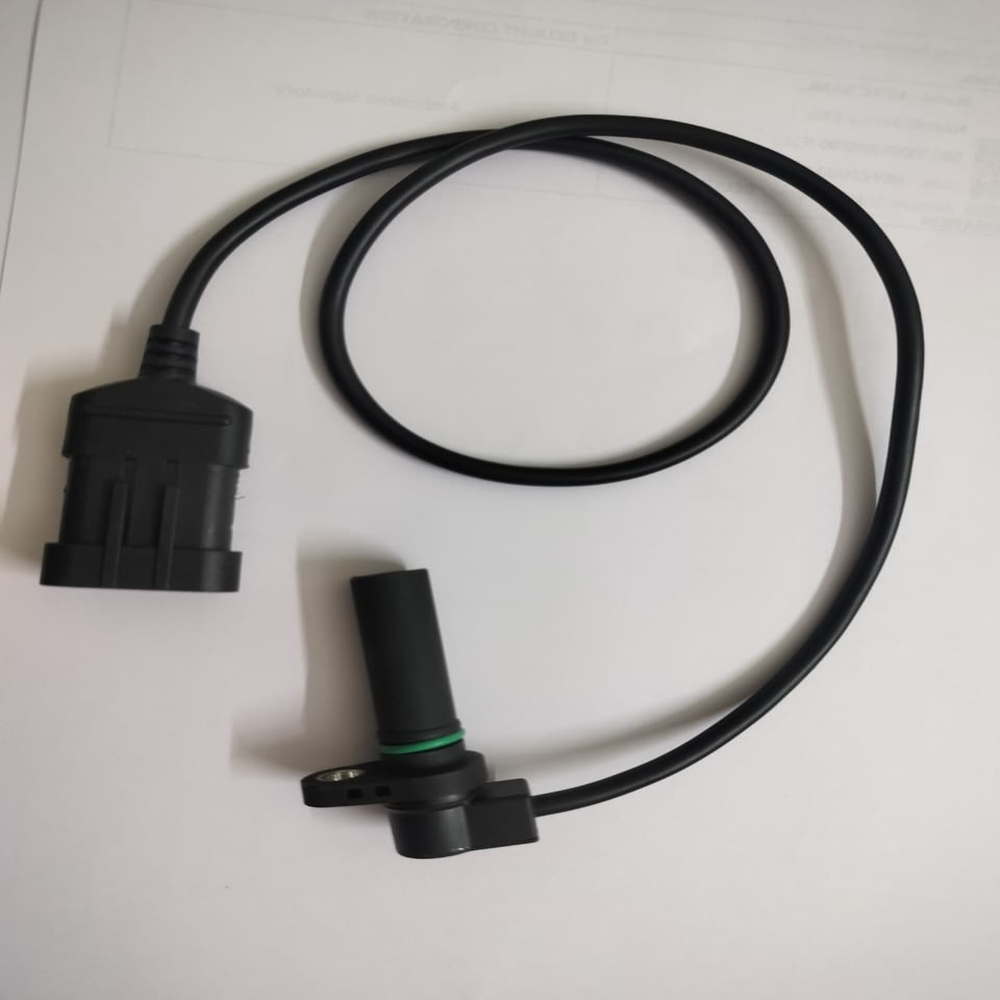
About FORKLIFT ENCODER
High quality forklift sensor suitable for Toyota, Hyundai, Godrej, Voltas, Linde, Yale-Hyster, Heli, Doosan & Jungheinrich forklifts. Durable performance and accurate sensing for industrial applications.
High Precision for Enhanced Forklift OperationsThis encoder delivers 1024 pulses per revolution, providing high-resolution feedback for precise control of forklift movement. Its digital output ensures compatibility with modern forklift systems, enabling accurate monitoring of position and speed, vital for safety and productivity.
Engineered for Industrial DurabilityBuilt with stainless steel and tough ABS plastic, the encoder is engineered for long-lasting performance. The IP65 rating safeguards against dust and moisture, while the heat-treated surface enhances corrosion and wear resistance, making it suitable for rigorous warehouse conditions.
Easy Installation and Versatile IntegrationThe shaft-mounted design, standard size, and 2-meter integrated cable simplify installation on most forklift types. Its compact dimensions and robust construction support seamless integration, whether retrofitting existing units or equipping new vehicles.
FAQ's of FORKLIFT ENCODER:
Q: How is the Forklift Encoder installed on a vehicle?
A: The encoder is shaft-mounted with standard dimensions, allowing straightforward installation on most forklift models. The 2-meter cable provides flexibility for routing, and its compact size (50mm diameter, 120mm length) facilitates positioning without interference.
Q: What are the main benefits of using this encoder in forklifts?
A: Integrating this encoder improves operational efficiency by delivering precise position and speed data. This enhances load handling accuracy, reduces errors, and contributes to overall safety in warehouse environments.
Q: When should I consider replacing or servicing the forklift encoder?
A: Routine inspection is recommended during regular forklift maintenance. Replacement or servicing should be considered if inaccurate readings, connection issues, or physical damage (such as exposed wires or casing cracks) are observed.
Q: Where is this encoder most commonly used?
A: This encoder is primarily used in forklifts within warehouses, distribution centers, and industrial sites where accurate speed and position sensing are essential for safe and efficient logistics operations.
Q: What is the process for integrating the encoder with forklift control systems?
A: Integration typically involves mounting the encoder to the relevant shaft, connecting the digital output cable to the forklift's control unit, and configuring the system to interpret the 1024 PPR signals for precise monitoring.
Q: What materials are used in the construction of the encoder, and why?
A: The encoder features stainless steel and ABS plastic for enhanced durability, corrosion resistance, and strength. The heat-treated surface furthers its ability to withstand harsh industrial environments.
Q: How does the protection class IP65 benefit the encoder's operation?
A: The IP65 rating ensures the encoder is protected against dust ingress and low-pressure water jets. This makes it reliable for continuous use in challenging forklift applications, minimizing downtime due to environmental factors.






 Send Inquiry


 Send Inquiry
 Send Inquiry
 Send SMS